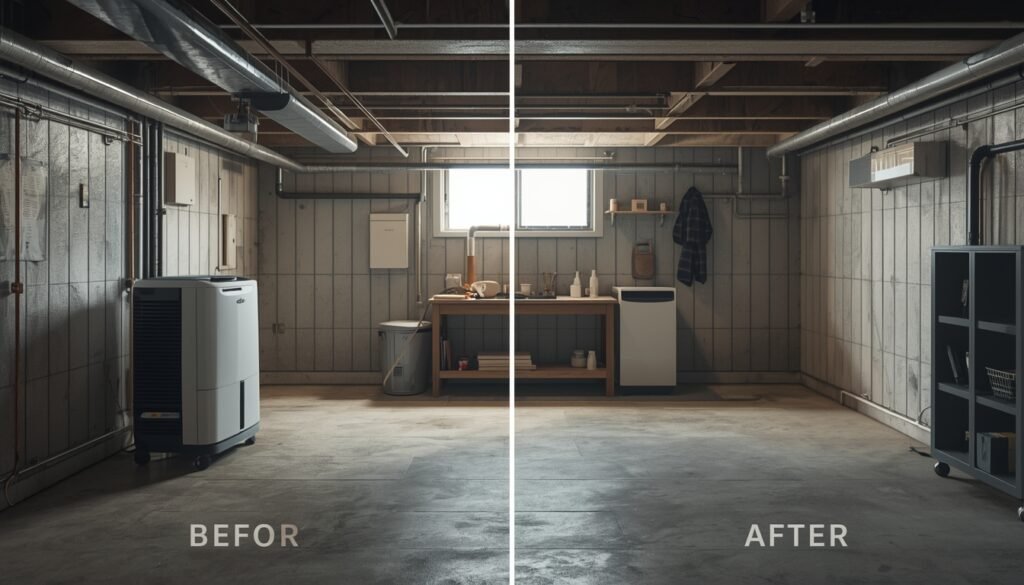
In most homes, a basement remaining humid even after running a dehumidifier is a sign that moisture is not being fully controlled rather than the unit not working at all. A common issue is expecting humidity levels to drop quickly and stay low, when in reality basements often have ongoing sources of moisture that a dehumidifier must continuously manage.
This typically happens when the amount of moisture entering or stored in the basement exceeds what the dehumidifier can remove. Many people find that the unit seems to be running properly, but humidity levels remain higher than expected because the conditions in the space are working against it.
What Still Humid Usually Means
- The air feels heavy or slightly sticky even after running the unit
- Humidity readings stay above 50 percent
- Musty smells linger despite continuous operation
- Condensation appears on pipes, walls, or floors
In most homes, these are the clearest signs that humidity is being replaced as quickly as it is removed. A common issue is assuming the dehumidifier has failed when the real problem is the amount of moisture the basement is dealing with.
The Most Common Causes
- The dehumidifier is too small for the size or dampness of the basement
- Moisture is continuously entering the space from outside
- The humidity setting is too high
- Airflow is limited, preventing proper circulation
- Moisture is stored in walls, floors, and materials
In most homes, it is not just one of these factors but a combination that causes persistent humidity. Many people find that once they address both the unit and the environment, the problem becomes much easier to solve.
The Dehumidifier May Be Undersized
One of the most frequent reasons a basement stays humid is that the dehumidifier does not have enough capacity. In most homes, an undersized unit will run continuously but still fail to reduce humidity levels enough to make the space comfortable.
A common issue is selecting a model based only on square footage rather than the actual dampness of the basement. Many people find that moving to a higher-capacity unit improves performance almost immediately.
Moisture May Be Entering Faster Than It Is Removed
A dehumidifier can only remove moisture that is already in the air. If moisture is constantly entering the basement, the unit may never fully catch up. In most homes, seepage through the foundation, poor drainage around the home, humid outdoor air, and condensation can all contribute.
Many people find that even a good dehumidifier struggles if outside moisture sources are not reduced. This typically happens because the unit is always working against a fresh supply of dampness.
Airflow Can Limit Performance
Air circulation is essential for a dehumidifier to work effectively. In most homes, poor airflow means the machine only affects the air immediately around it while other areas of the basement stay humid.
A common issue is placing the unit too close to walls or surrounding it with storage. Many people find that moving the unit to a more open location or using a fan improves humidity control because more air is able to circulate through the space.
Moisture Stored in Materials Takes Time
Even if the air starts drying, humidity may stay high because moisture is stored in concrete, wood, fabrics, and other materials throughout the basement. In most homes, this is one of the biggest reasons humidity readings do not drop as fast as expected.
Many people find that several days of continuous operation are needed before stored moisture begins to release fully and the environment stabilises.
The Humidity Setting May Be Too High
Another common issue is setting the dehumidifier to a humidity level that still allows the basement to feel damp. In most homes, settings above 50 percent may not be enough to produce a dry, comfortable result.
Many people find that lowering the setting into the 30 to 50 percent range produces a more noticeable difference, especially when the basement has a history of moisture problems.
How to Fix the Problem
Improving results usually means increasing dehumidifier capacity if needed, lowering the humidity setting, improving airflow, and reducing outside moisture sources. In most homes, the biggest improvements come when these steps are combined rather than handled one at a time.
A common issue is expecting one quick change to solve persistent humidity. Many people find that a few coordinated adjustments create much better long-term control.
When to Be Concerned
If humidity stays above 50 percent after several days of continuous use, musty smells continue to worsen, or visible mold and condensation are still present, the basement may have a larger moisture issue. In most homes, that means there is either too much incoming moisture or the unit is not capable of handling the load.
Many people find that this is the point where looking at drainage, seepage, or dehumidifier replacement becomes necessary.
Final Thoughts
If your basement is still humid after running a dehumidifier, it usually means the unit is not fully keeping up with the conditions in the space. In most homes, the issue is related to capacity, airflow, moisture entry, or stored dampness rather than total equipment failure.
By identifying which of these factors is responsible, you can improve performance and create a basement that stays drier, more comfortable, and much easier to manage over time.
If you want a broader overview of basement moisture, humidity control, and how dehumidifiers fit into the bigger picture, see our Complete Guide to Basement Dehumidifiers.