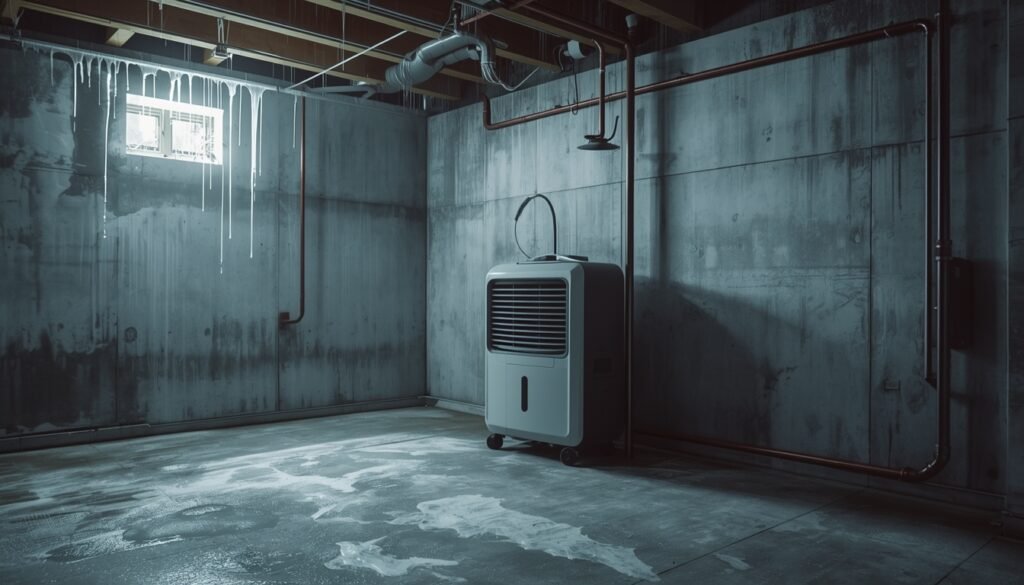
In most homes, you can absolutely use a dehumidifier in an unfinished basement, and in many cases it is even more important than in a finished space. A common issue is assuming that because a basement is unfinished, it does not need moisture control. In reality, unfinished basements are often more exposed to moisture and can benefit significantly from a dehumidifier.
This typically happens because unfinished basements have exposed concrete walls, open structural areas, and limited insulation. These conditions allow moisture to enter more easily and remain trapped in the space, even without visible leaks.
Why Unfinished Basements Are More Prone to Moisture
- Concrete walls and floors absorb moisture from the surrounding soil
- Open structures allow air and humidity to move more freely
- Lack of insulation means temperature differences can create condensation
- Poor airflow can cause moisture to linger in certain areas
In most homes, these factors combine to create a damp environment. Many people find that even if there is no obvious water, the basement still feels humid or develops a musty smell over time.
What Problems Can Occur Without a Dehumidifier?
Even though an unfinished basement may not be used as a living space, excess moisture can still cause a wide range of problems. Stored items can absorb moisture, metal can rust, wood can hold dampness, and mold or mildew can begin developing on structural surfaces.
A common issue is ignoring these problems because the basement is not seen as a finished part of the home. Many people find that by the time they notice serious odors or damage, humidity has already been present for quite a while.
How a Dehumidifier Helps in an Unfinished Basement
A dehumidifier works the same way in an unfinished basement as it does in any other area. It removes excess moisture from the air, helping reduce the damp conditions that lead to odors, mold, and material damage.
In most homes, the difference can be noticeable within a short time. Many people find that the air feels lighter, odors decrease, and the space becomes easier to manage once humidity is controlled consistently.
Where Should You Place It in an Unfinished Basement?
- Place the unit in an open area rather than a corner
- Avoid putting it directly against walls or obstacles
- Keep the surrounding space clear for good airflow
- Position it near the dampest area if one section is worse than others
Placement matters because airflow is often uneven in unfinished basements. Many people find that simply moving the unit away from storage or structural obstructions makes a noticeable difference in performance.
Do You Need a Special Dehumidifier?
In most homes, you do not need a special type of dehumidifier just because the basement is unfinished, but you do need a unit with the right capacity. A common issue is underestimating how damp an unfinished basement really is and buying a model that is too small.
Many people find that a slightly larger-capacity unit performs better in this environment because exposed concrete and open structural spaces often mean ongoing moisture loads are higher than expected.
Are There Any Limitations?
While dehumidifiers are effective, they do not stop moisture from entering the basement in the first place. In most homes, they work best as part of a larger moisture-control approach that may also include better drainage, sealing, or improved airflow.
A common issue is expecting the dehumidifier alone to solve every dampness problem. Many people find that it controls humidity very well, but deeper sources of water entry still need attention if they are significant.
How to Get the Best Results
Set the humidity between 30 and 50 percent, keep the unit running consistently, and monitor conditions with a hygrometer if possible. In most homes, stable humidity matters more than occasional short bursts of drying.
Many people also find that removing damp cardboard, keeping items off the floor, and allowing more open space around the unit helps the unfinished basement stay drier for longer.
Common Mistakes
One common mistake is assuming an unfinished basement does not need moisture control simply because it is not finished living space. Another is using a unit that is too small or placing it in a blocked corner where it cannot circulate air properly.
Running the dehumidifier inconsistently is another issue, because humidity often returns quickly when the unit is turned off for long periods.
Final Thoughts
You can and should use a dehumidifier in an unfinished basement if humidity levels are elevated. In most homes, unfinished basements are actually more prone to moisture, making humidity control especially important.
By choosing the right unit, placing it properly, and using it consistently, you can reduce dampness, protect stored items, and keep the basement much easier to manage over the long term.
If you want a broader overview of basement moisture, humidity control, and how dehumidifiers fit into the bigger picture, see our Complete Guide to Basement Dehumidifiers.