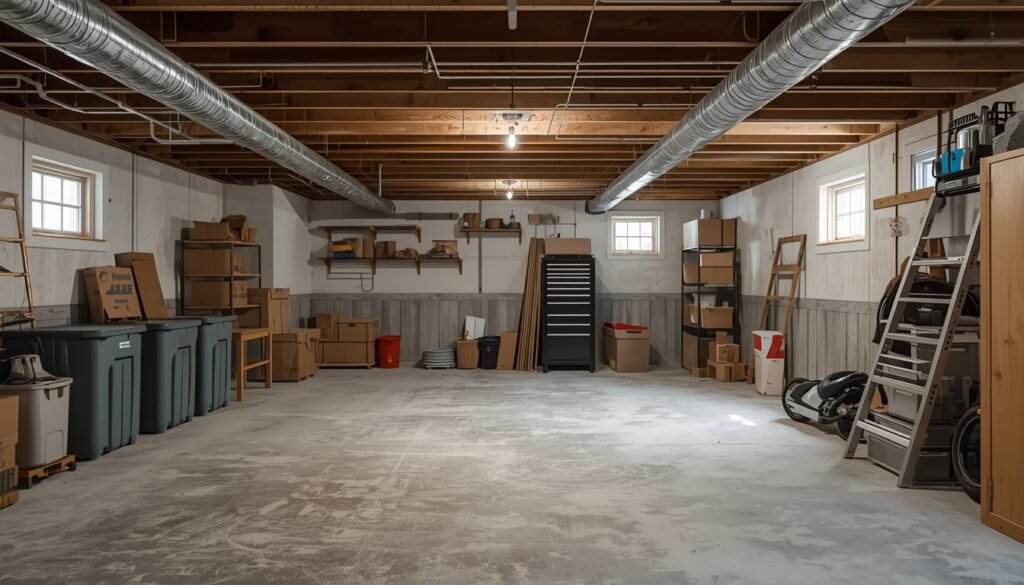
Choosing between a small or large dehumidifier for your basement is one of the most common decisions homeowners face when trying to control moisture. In most homes, basements naturally collect humidity due to their location below ground level and limited airflow. A common issue is that people choose a unit based only on size or price without considering how damp the basement actually is.
This article explains whether you should choose a small or large dehumidifier, how each option affects your basement in real-world situations, the signs you may have the wrong size, and how to make the best decision. Understanding this helps you avoid ongoing humidity problems and get better performance from your unit.
In simple terms, a larger dehumidifier is usually the better choice if your basement has moderate to high humidity, while a smaller unit may only be suitable for lightly damp spaces.
What Is the Difference Between Small and Large Dehumidifiers?
The main difference between small and large dehumidifiers is their moisture removal capacity. This is measured in pints per day, which indicates how much water the unit can remove from the air within 24 hours.
In most homes, small units typically remove around 20 to 30 pints per day, medium units remove around 30 to 50 pints per day, and large units remove 50 pints or more per day.
A common issue is assuming that physical size matters more than capacity. This typically happens when homeowners focus on how the unit looks rather than what it can do.
When Is a Small Dehumidifier Enough?
A small dehumidifier can work well in certain situations. In most homes, it is suitable for basements that are only slightly damp and have minimal moisture issues.
A common scenario is a basement that feels a little humid during warmer months but does not have odors, condensation, or signs of mold.
For example, if your basement stays below or close to 50 percent humidity most of the time, a small unit may be enough to maintain a comfortable level.
When Should You Choose a Large Dehumidifier?
A large dehumidifier is often the better choice for basements with moderate to high humidity. In most homes, this includes basements that feel damp, have musty smells, or show signs of condensation.
A common issue is underestimating how much moisture is present. Many people find that their basement is more humid than they initially thought, especially during warmer or wetter seasons.
For example, if you notice condensation on pipes or walls, or if the basement feels consistently damp, a larger unit will be more effective at bringing humidity down quickly.
Signs You Chose the Wrong Size
If the unit is too small, it runs constantly but the basement still feels damp, humidity levels remain above 50 percent, musty odors do not improve, and condensation or mold continues to appear.
If the unit is too large, it may cycle on and off very quickly and may not run long enough to circulate air properly. Many people find that a unit that is slightly larger than needed performs better than one that is too small.
Why Larger Is Often the Better Choice
In most basements, choosing a slightly larger dehumidifier provides better results. A common issue is that smaller units struggle to keep up with moisture, especially during periods of high humidity.
This typically happens because a larger unit can remove moisture more quickly and reach the desired humidity level faster. Once that level is reached, the unit can cycle on and off, which improves efficiency.
For example, many homeowners find that upgrading to a larger unit reduces how long the dehumidifier needs to run each day.
Key Factors to Consider Before Choosing
- The size of your basement
- The level of humidity or dampness
- Seasonal changes that affect moisture levels
- Airflow and ventilation in the space
In most homes, humidity level is the most important factor. A common issue is focusing only on square footage without considering how damp the space actually is.
How to Make the Right Choice?
- Measure or estimate the size of your basement
- Look for signs of humidity such as odors or condensation
- Choose a unit that can handle your current and seasonal moisture levels
- When in doubt, select a slightly larger unit for better performance
For example, many homeowners find that choosing a larger unit gives them more consistent results and fewer humidity problems over time.
Common Mistakes
One common mistake is choosing a small unit to save money, only to find that it cannot handle the moisture levels. Another is ignoring seasonal changes, which can increase humidity significantly.
Some homeowners also assume that all basements are the same, when in reality conditions can vary widely.
Placing the unit in a poor location or not using it consistently can also reduce its effectiveness.
If you want a broader overview of how basement moisture, humidity levels, and dehumidifier use all fit together, see our Complete Guide to Basement Dehumidifiers.
Final Thoughts
Choosing between a small or large dehumidifier depends on your basement’s size and moisture level. In most homes, a larger unit is often the better choice because it provides more reliable moisture control and better long-term results.
By understanding your basement conditions and selecting the right capacity, you can maintain a dry, comfortable environment and avoid ongoing humidity problems.